Analysis of Existing Offset Data Along the Cholame and Carrizo Segments of the San Andreas Fault
Discussion
Summary and Conclusions
Acknowledgements
References
Abstract
Traditionally, fault segments are defined based on repeating characteristic events seen in accumulated geomorphic offsets along a fault trace and trench records that can be collected only in areas with good preservation conditions and simple fault geometries. During ruptures that span multiple segments, abrupt changes in the slip distribution may be evident at a segment boundary (e.g., the central vs. the northern segment of the Imperial Valley Fault during the 1940 and 1979 Imperial Valley earthquakes). This similarity in slip from event to event may result from sustained loading conditions, geometric irregularities along the fault surface, and/or strength contrasts between the different segments.
We present a method that uses observed microseismicity and boundary element models to interpret historic slip data along low friction, vertical, strike-slip faults (i.e., faults along which strength differences can be characterized by differences in the critical shear stress required to produce ruptures). Microseismicity defines the rough geometry of the brittle fault. The offset data along the fault may show changes that can be explained by changes in down dip fault geometry and/or changes in the physical properties of the areas of the fault with different down dip geometries. We use boundary element models of frictionless faults that experience a total stress drop to quantify the range of contrasting strengths (in MPa) required to produce the surface slip observed in the offset data by applying different stress drops to the areas of the fault whose geometry is defined by the microseismicity. If the surface offset can be explained by a uniform stress drop applied to both segments whose down dip geometry is evident from microseismicity, there is apparently no strength contrast between the segments. In that case, the segment boundary may not be based on a change in the fault surface strength; therefore, rupture terminations may be controlled by previous loading along the fault and geometric effects. If these contributions are not significant, ruptures across these ``suspect boundaries'' may not show spatial and/or temporal regularity. If the surface slip distribution requires a non-uniform stress drop in which one segment experiences at least twice the stress drop of the other segment, prior loading alone cannot explain the surface slip, thus a strength contrast between the two segments is required. This strength contrast defines a segment boundary that will remain constant as long as the magnitude of accumulated slip is much less than the total length of the segment (10 - 100 kyr for a fault slipping at ≈35 mm/yr).
We present normalized plots for low-friction fault segments of various geometries and strengths that show the expected slip distribution for a single rupture event. We consider strength ratios of one segment to the other of 1/4, 1/3, 1/2, 1, 2, 3, and 4 for a range of fault geometries. These plots may be used along low-friction faults to constrain the physical parameters for the fault segments. Thus, in areas where little paleoseismic data are available, surface slip data, coupled with microseismicity studies may be used to define segments and segment boundaries and their approximate physical properties. In addition, we examine the case of a fault that is driven by a constant displacement rate. Over long time scales, deficits in slip between segments with different geometries must be resolved by non-characteristic “catch-up” events on faults with lower slip per characteristic event. We provide calculations of the difference in peak slip between two segments of equal strength in order to determine which down dip fault geometry cases produce significant rupture segmentation without strength contrasts.
This analysis is applied to the Cholame and Carrizo segments of the
San Andreas Fault. The Cholame segment is 56 km long and
14 km
deep and the Carrizo segment is 114 km long and 22 km deep (depth is
defined by the microseismicity). The 1857
Fort
Tejón earthquake offset data suggest that the slip increases where
the
fault deepens. The surface offset data between the Cholame and
Carrizo
segment of the SAF require a 2/3 to 1/4 strength ratio of the
Cholame
segment to the Carrizo segment.
Introduction
Rupture segmentation results in patterns of spatially consistent ruptures of approximately equal magnitude occurring at generally regular temporal intervals. This behavior may result from spatial variation in fault surface strength, geometric changes in the fault surface which may enhance or decrease slip in an individual event, and consistent spatial changes in the loading distribution acting along a fault surface. The definition of fault segments based solely on the analysis of paleoseismic data (e.g., geomorphic offsets, trenching studies, and offsets of cultural features) does not differentiate between these phenomena. Therefore, the rupture sequence that is observed over several earthquakes may be part of a more complex spatial and temporal pattern of rupture that can only be understood by deducing the controlling parameters of the physical processes responsible for segmentation.
The idea of fault segmentation has been a useful tool for paleoseismology in characterizing earthquake behavior (e.g., Schwartz and Coppersmith, 1984; McCalpin, 1996). According to the principle of fault segmentation, knowledge of the spatial and temporal distribution of earthquake ruptures may show a consistent pattern that can be extrapolated to forecast the timing and magnitude of future events (for example, applications of these characteristic models can be found in WGCEP, 1988). In this model, earthquake magnitudes (and thus, offset distribution if the rupture length does not vary from event to event) cluster around a given magnitude with a small range of possible values near the characteristic magnitude (Arrowsmith et al., 1997; Schwartz and Coppersmith, 1984). These types of characteristic events can be seen as accumulated geomorphic offsets along a given segment as well as in evidence of ground rupture recorded in trench records. Where datable material can be located in the stratigraphy of these trenches, the timing of each event may be constrained.
Characteristic earthquakes may produce long-term slip deficits towards the ends of the segments, as well as between segments with different strengths or down-dip geometries. For fault segments with a constant long-term slip rate, accumulated slip deficits must eventually be resolved by failure on the segment along which the deficit has occurred, failure along another structure parallel to the area of the slip deficit, or distributed deformation adjacent to the fault (such as contractional or dilational structures). In order to at least partially reconcile this problem, Schwartz and Coppersmith (1984) allow for spatial overlap between characteristic events which may resolve slip deficits. However, McCalpin (1996, p.479) argues that these deficits may accumulate without non-characteristic events resolving the deficits. For faults such as the San Andreas Fault that show a relatively constant long-term slip rate between Parkfield (≈30 mm/yr; Burford and Harsh, 1980) and Wallace Creek (≈35 mm/yr; Sieh and Jahns, 1984), “catch up” events are required at the interface between segments with different characteristic ruptures (Sieh and Jahns, 1984; Arrowsmith et al., 1997).
During a rupture, a segment may act as an independent seismic source or may rupture with adjacent fault segments. For example, the 1940 Imperial Valley earthquake (M=7.1$) ruptured all three segments of the Imperial Fault, for a total length of ≈60 km. During this earthquake, there was a relatively small amount of surface slip in the Northern Imperial segment of the fault (≈1 m of right lateral strike-slip movement), while the Central Imperial Fault segment slipped over 5 m (Figure 1). In this rupture, large slip gradients along the rupture were observed and used to define the segment boundaries. A second earthquake along the Imperial Fault in 1979 (M=6.6) only ruptured the Northern Imperial segment, resulting in surface offsets of ≈1 m (Figure 1). This example illustrates several properties of a fault segment: 1) its ability to act in concert with other segments (e.g., 1940 earthquake) or independently (e.g., 1979 earthquake), 2) the presence of large slip gradients across segment boundaries and different peak slip magnitudes along different segments of a fault in a given rupture, and 3) the repeatability of slip from event to event as manifest by the correspondence between the offset magnitude experienced on the northern segment during both the 1940 and 1979 event (Ward, 1997).

Figure 1: Surface offset distribution during the 1940 and 1979 earthquakes along the Imperial Fault, California. Note that slip during the two ruptures is partitioned into different fault segments: where slip is large in the 1940 event (the edge of the southern Imperial Fault segment), the 1979 slip dies out to zero. Figure adapted from Arrowsmith et al. (1997).
The observations that may lead us to define a segment boundary may be the product of several different physical processes, including differences in the long term fault loading, down-dip fault geometry changes, and fault strength variations. First, a portion of a fault may be loaded consistently differently than other areas of the fault, producing areas on the fault surface that fail independently of other parts of the fault surface. For example, two parallel, vertical strike slip faults that overlap will result in a “stress shadow” (Willemse, 1997) where the remote loading is taken up on both faults. Therefore, there will be discrepancies in loading conditions along each of the parallel faults over long time scales, relative to the long-term loading of a fault in isolation. Secondly, the fault geometry may effect segmentation. For example, taller faults will accumulate greater displacement for a given stress drop than shorter faults. If the long-term fault slip rate is spatially constant along the length of the entire fault, then a significant difference in down-dip fault geometry must result in segmentation. In this case, shallower segments will slip less in an event that spans multiple segments; therefore, the shallower segments must “catch-up” with the long-term fault slip rate by independent events along the shallower segments of the fault system. Finally, fault strength may result in segmentation. For a fault that does not deepen with depth and experiences constant loading in space, a segment that can bear a higher shear stress will rupture less frequently than neighboring segments that have lower shear strength. Therefore, segments with higher fault strengths should rupture in larger and less frequent events than neighboring fault segments.
The definition of fault segments based on assessing a fault's rupture history may lead to inaccurate estimations of the timing and magnitude of events along a fault. While several different physical mechanisms may interact to produce an observed behavior, the same combination of physical properties may produce behavior that mimics regular behavior over several earthquakes, but is actually part of a long, complex rupture sequence which is not resolvable solely with paleoseismic observations. In our simplified model of rupture segmentation presented below, the spatial and temporal pattern of rupture depends on the fault geometry, fault friction, and loading conditions imposed upon the fault. Therefore, it is logical to define fault segments based on these physical parameters. While there are more sophisticated models for earthquake recurrence (including frictional effects; Ward, 1997) and rate and state dependent failure laws (e.g., Segall and Rice, 1995) these simplified models allow us to capture the essence of rupture segmentation for low friction faults over long time-scales without introducing several more controlling factors that may not be resolvable from paleoseismic data.
The shape of the rupture offset distribution will be influenced by the same factors that influence the degree of segmentation a fault may show: fault geometry, fault strength, and loading conditions. The paleo-surface offset distribution for a series of events may be reconstructed from a series of measurements of geologic and geomorphic offsets across the fault. If we can estimate the geometry of a series of segments along a strike-slip fault from microseismicity, then we can use mechanical models to calculate the surface slip expected from a fixed fault geometry for various strength contrasts between the segments. By comparing the surface offset distribution predicted by the model and the surface offset distribution inferred from the offset features, we constrain the contrast in strength between the two segments of the fault. In this way, we can begin to define fault segments based on their physical parameters (fault geometry and fault strength), rather than simply on our observations of past behavior.
In this paper, we present the results of a range of numerical experiments in which we systematically vary the fault geometry, fault strength, and fault loading conditions. These results are presented as normalized plots and are intended to be used as a paleoseismological tool to constrain the physical parameters of a set of adjacent, coplanar suspect fault segments. These plots can be applied to any surface offset distribution along a low friction fault along which the down dip fault geometry can be constrained by microseismicity.
In order to demonstrate this method and elucidate the nature of segmentation along the San Andreas Fault (SAF), we analyze surface offset data collected between Cholame and the Carrizo Plain, California in order to quantify the strength contrast proposed by (Sieh, 1978) across the Cholame-Carrizo segment boundary. This segment last ruptured during the 1857 Fort Tejón Earthquake (M≈7 3/4). This ≈300 km long earthquake produced peak offsets of 11 m within the Carrizo Plain, CA (Sieh, 1978; Sieh and Jahns, 1984; Grant and Donnellan, 1994). Since that time, five earthquakes have occurred at the northern 1857 rupture at Parkfield; however, these ruptures did not penetrate deeply into the Cholame segment and did not rupture the Carrizo segment of the SAF (Lienkaemper and Prescott, 1989) (Figure 2). Therefore, segmentation along this stretch of the San Andreas Fault appears to greatly influence fault rupture behavior. In effect, the Cholame segment may be acting to accommodate disparate magnitude events between the characteristically low magnitude Parkfield events, and the high magnitude Carrizo events. Knowledge of the physical parameters that act to produce the single- or multi-segment ruptures may allow us to understand how this boundary behaves as the result of ruptures along the Parkfield segment. We reconstruct the 1857 M≈ 3/4 Fort Tejón Earthquake offset distribution as well as the offset distribution of other ruptures in the region in order to constrain the physical parameters that may have led to the observed offset distributions. This study provides new techniques for constructing offset profiles from geomorphic offsets, correlating earthquakes within the geomorphic data (as constrained by paleoseismic investigations along the fault in areas of geomorphic offsets), and estimating physical fault parameters which define the geometry and strength of segments. From our analysis, we suggest several revisions to the way that paleoseismologists define and describe both fault segments and geomorphic offsets.
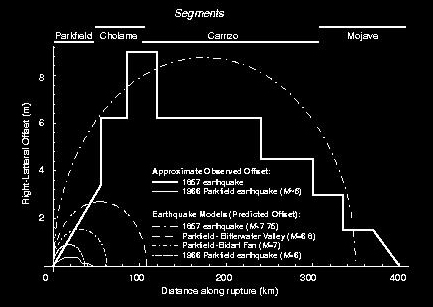
Figure 2: The generalized surface slip distribution during the 1857 Fort Tejón Earthquake. The earthquake apparently nucleated in Parkfield, CA and ruptured more than 300 kilometers to the southeast. Since that time, the Parkfield segment has failed five times, yet the Carrizo, and much of the Cholame segment has not failed. Modified from Arrowsmith et al. (1997).
Relating Coseismic Surface Offsets to Fault Strength, Geometry, and Loading
If the surface offset is a function of the fault strength, geometry, and loading, we must constrain two of these variables in order to solve for the other variable. Below, we systematically address the issues associated with constraining the fault geometry and estimating the maximum impact of loading conditions on our estimation of fault strength from coseismic surface offset data. Finally, we address the issue of the tradeoffs between spatial and temporal coverage in both geomorphic offsets and trench studies in reconstructing the paleo-slip distribution for a series of ruptures.
Fault geometry may be estimated by assuming that small earthquakes occur along the length and depth of the fault that will experience rupture (i.e., the brittle extent). While microseismicity gaps may occur in areas that may be likely to fail (Lees, 1990), we assume that observing microseismicity over longer time periods improves our ability to resolve down-dip fault geometries. Therefore, this analysis is best applied to regions with seismicity catalogs of long duration collected from areas that are well instrumented. In this study, we choose to concentrate solely on the location of microseismic events to define the brittle fault surface. If we assume that the the loading history along the fault does not significantly effect a rupture distribution, and we can estimate the down-dip fault geometry based on our observations of microseismicity. With the fault slip distribution and fault geometry, we can estimate the difference in fault strength between two adjacent segments of the fault. The estimation of the slip distribution over the depth of the fault surface during a rupture requires a detailed analysis of the strong motion data recorded during a rupture (e.g., Wald and Heaton, 1992) and can not be determined for past events that were not well instrumented during the time of rupture. However, surface offsets are recorded by offset geomorphic features and by offset geologic units observed in trench studies. This surface offset distribution provides a one-dimensional glance at the slip distribution during a rupture. In addition, mechanical models considering a constant stress drop across the surface of the fault show that the surface offset records nearly the peak offset for strike-slip events and contains much of the information about the rupture. Therefore, paleoseismologists use geomorphic and geologic offsets along the length of several segments to determine the offset distribution for a single rupture, and possibly several past ruptures.
Loading along a fault may be difficult to discern from field data without knowing the fault geometry and fault strength a priori. However, over large spatial extents and long time scales, loading from past ruptures likely will change along length of the fault and thus act as random perturbations in the long-term loading. In addition, the effects of loading conditions on a fault segment can be isolated from geometric and strength effects for a given range of fault strengths and geometries. The final parameter, fault strength, may play an important role in the behavior of the fault segment; however, the fault strength is difficult or impossible to measure directly.
Offsets determined within trenches can be collected only in areas
with ideal preservation conditions and simple fault geometries.
Therefore,
their limited spatial coverage does not easily constrain the spatial
distribution of slip along length of the fault for a given rupture.
Conversely, geomorphic offsets provide much broader spatial coverage
of a series of ruptures; but the interpretation of offset
features can make quantitative studies of slip distributions
problematic (e.g., Lienkaemper and Sturm, 1989). By filtering the
geomorphic
offset data by weighting it according to its uncertainties, we can
quantitatively correlate offset distributions determined by
geomorphic offsets to different ruptures which may be dated in trench
records.
Modeling fault segment friction, strength, and
geometry
Conceptual and numerical models of physical processes can be used to
bridge
observations of observed slip during and earthquake and
the
stresses which caused the slip. Observations collected along a fault
trace record a measure of the surface offset at points along a fault
due to
one or more earthquakes. Fault properties such as strength
define the critical shear stresses acting on the fault surface that
initiate rupture. In order to relate fault parameters (such
as
relative strength) to an observed surface offset distribution, we use
elastic boundary value solutions to model a planar crack subject to
a stress
drop
across its surface. We assume that the crack is embedded in a
homogeneous,
linear elastic half-space and is in quasi-static equilibrium.
Furthermore, we assume that the stress drop across the fault surface
is uniform and complete. These
models have successfully
explained deformation in fault steps along the San Andreas Fault
(e.g., Segall and Pollard, 1980), explained slip distributions
along faults
(Bürgmann et al., 1994), and have been used to estimate
fault slip rates and their distribution in time from
geodetic data (e.g., Bürgmann et al., 1998).
Fault strength can be defined in several ways. Zoback et al.
(1987)
define fault strength in terms of a maximum shear traction that the
fault can support before failure:
| So=k | (1) |

In this definition of fault strength, strength is independent of depth or other loading conditions.
 |
(2) |
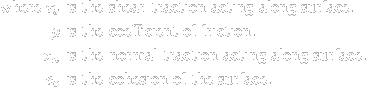
Another formulation of fault strength is defined by assuming that frictional resistance along the fault surface scales the shear strength of the fault with the normal traction acting along the failure surface. This failure criterion, called the Coulomb Failure Function (CFF), can be expressed as (Jaeger and Cook, 1969):
Thus, when the Coulomb Failure Function is greater than zero, failure will result. In the Coulomb formulation of fault friction, if the fault friction is low, then the shear strength of the fault is nearly independent of the normal traction, and so is approximated by the fault surface cohesion. Under these conditions, the Coulomb Failure Criterion (eq. 2) reduces to the formulation of shear strength of Zoback et al. (1987) (eq. 1) in which $c_{o}=k$. We distinguish between the terms “fault strength” and “fault friction” in this paper: when using the term “fault friction”, we are referring to the value of $\mu$ in equation (1), when using the term “fault strength”, we are assuming the fault friction is low, thus the shear strength of the fault is constant and is equal to the fault surface cohesion.
Our analysis is conducted for fault strength contrasts along low friction faults. In this case, we can represent strength contrasts by applying different magnitude stress drops across different segments of the fault surface. We make the assumption of low fault friction for several reasons. First, the fault segments to which we apply our analysis (Section III) are likely to be low friction faults based on near fault principal stress rotation (Zoback et. al, 1987), the lack of frictional heat observed in the proximity of the fault zone, the presence of contractional structures that have been active over the Quaternary adjacent to the San Andreas Fault (Hickman, 1990). More importantly, the assumption of low friction allows us to generalize our results by creating normalized plots that are scale independent. By including friction in the analysis, we must consider the effects of lithostatic loading on the fault surface, remote boundary conditions, and pore pressures that may spatially vary across the fault surface. The lithostatic loading inherently introduces a dimension of length, and prevents us from generalizing our results.
We assume that a total stress drop occurs across each fault segment and that all displacements are coseismic. Studies of postseismic displacements in the Bay Area (e.g., Bürgmann et al., 1997) show that significant postseismic displacements can accumulate at distance from the fault. While these displacements may contribute to the total displacement around the fault, postseismic relaxation of the surrounding material is insignificant near the fault and increases perpendicular to the fault with a dimension that scales with the depth of the fault (Pollitz, 1992). Because geomorphic offsets record near-fault deformation, these offsets should be relatively insensitive to these types of postseismic displacements. However, for faults that are prone to creep, significant postseismic displacements can accumulate along the fault surface. For these types of displacements, we assume that either they are insignificant or they act uniformly along the length of the fault to increase the observed coseismic displacements. In any case, postseismic slip acts to relieve stresses on a fault and so is directly influenced by the strength of the fault. In addition, paleoseismic studies usually consider both coseismic and postseismic offsets together when describing characteristic events (Sieh, 1995).
The fault surface may not experience a total stress drop as reloading of a fault patch by movement along another fault patch may occur dynamically during the rupture process. This history of loading of the fault surface may produce offset distributions which may mimic strength contrasts. In order to determine the effects of prior loading on the apparent strength contrast between segments, we consider the case of two segments of equal strength, one of which is loaded just below its critical shear strength. Both segments are then instantaneously loaded to induce failure on both segments. In this case, if the stress drop is complete across both segments, the stress drop across the first segment is one half of the stress drop across the second segment. This is the limiting case for prior loading, as any further loading on the segment with prior loading would exceed the critical shear strength of the segment and result in failure. The apparent strength contrasts caused by incomplete stress drops in previous events cannot produce an apparent strength contrast between segments equal to or greater than 1:2. Furthermore, even in the case of instantaneous loading, a fault cannot be loaded beyond its strength, even in the case of instantaneous loading. Therefore, it is unlikely that an apparent strength contrast as large as 1:2 can be produced by prior loading. Finally, while the apparent strength contrast of 1:2 is possible, it is unlikely that one of the segments is loaded to its critical strength, while the other has experienced no accumulated stress. Therefore, the possibility of an apparent strength contrast resulting from prior shear stresses acting along the fault decreases as the apparent strength contrast decreases from 1:1 to 1:2. We use an elastic dislocation model (DIS3D; Erikson, 1987; as modified by Rubin, 1988) to perform our calculations. The model uses rectangular dislocations driven by displacement boundary conditions acting across element surfaces. The model developed by Erikson (1987) assumes the displacement across each dislocation is constant. We define relative strength contrasts as a difference in shear stress acting along the fault surface; therefore, constant displacement boundary conditions cannot model strength contrasts (because constant displacement boundary conditions require non-constant traction boundary conditions). The modifications made by Rubin (1988) allow for constant traction boundary conditions acting across an arbitrary number of sub-elements in a rectangular dislocation loop. Slip along a patch of the fault will result in loading on all other parts of the fault. By slipping each patch to see how the other patches are loaded, we can iteratively slip each patch until the stresses acting across each part of the fault surface equal the prescribed boundary conditions (following the methods of Muskhelishvili, 1954; Sokolnikoff, 1956) . In addition, fault friction can be prescribed to act over the crack surface and inter-penetration of the element surfaces can be restricted, although we did not consider these factors in our analysis. These modifications extend Erikson's (1987) model such that fault strength contrasts can be adequately modeled. Based on our assumptions of low fault friction, we normalize the dimensions of the segments in our model to one another and also normalize the offset distribution with respect to the maximum offset. We idealize the fault as being a straight, vertical plane. In our study, we model the simple case of two surface rupturing fault segments, one of which may be deeper than the other. Figure 3 shows the fault geometries considered in our study. The fault segment dimensions are uniquely defined by three ratios, the length of the shallow segment normalized to the total fault length (a/c), the difference in depth between the shallow segment and the deeper segment normalized by the depth of the deep segment (e/d), and the ratio of the depth of the deep segment and the total fault length (d/c). While our geometry defines the shallow segment to be the segment leftmost segment, the segment geometry may be reversed by making a mirror image about a vertical projection axis for any of the figures in this study.

Figure 3: Definition of model fault segment geometry. The geometry of two rectangular, vertical fault segments is uniquely defined by a set of ratios that relates the length of the a fault segment to the total fault length, the length of the fault to the depth of the fault, and the depth of the shallow fault segment to the depth of the deep fault segment. We use these three ratios (a/c, e/d, and d/c) in order to define our model geometries. The strengths of the short and tall fault segments are labeled S1 and S2, respectively.
We assume that there are no significant deviations in the strike of
the fault along its length. Deviations in strike may significantly
effect
the long-term loading distribution acting along the fault and may
make structures around
the fault oriented more favorably for failure. These
complications
are important, yet they are
beyond the scope of this paper. We focus our study on straight
planar faults to present a general exploration of the effects of down
dip
fault depth increases and strength contrasts on the offset
distribution.
Results
In this section, we present two sets of results. The first set of
results are
the general results of our forward modeling of different fault
segment
geometries on the surface slip distribution. In the second, we
consider
fault geometries similar to those of segments
along the SAF. In particular, we model the changes in geometry of
the Cholame and Carrizo segments of the SAF. These results are then
compared to a filtered offset distribution in the next section.
General Model Results
We systematically varied the fault segment geometries and the fault segment friction in order to determine the relative importance of geometry and frictional difference on the offset that we expect to result from movement along the fault. While our models provide us with the slip distribution acting across the entire fault surface, we present only the slip distribution at the surface because 1) the slip distribution at the surface is the only parameter that we can can reconstruct from geomorphic offset and trenching data, and 2) the presentation of the calculated slip along the entire fault surface is more information that can be presented in this article. In order to provide the calculated normalized values of slip for all points along the fault surface, we have created a web site on the World Wide Web (WWW) that presents the complete data set (http://activetectonics.la.asu.edu/segmentation).
In all of our models, we normalize the slip in the area of interest
to the maximum value of slip in that area. For example, if we are
considering the slip distribution along the entire fault surface, all
values of the fault slip are normalized to the
maximum
slip observed. However, in the case that we are only considering the
surface slip distribution resulting from a given rupture, the values
of slip are normalized to the maximum surface slip value. Therefore,
direct comparison of the normalized surface slip values to the
normalized slip values is not
possible, for the same point may be normalized to two different
maximum values in this scheme.
The Effect of Fault Segment Geometry on Surface Slip
Distribution
We can gain intuition about how the offset for a given event is influenced by geometry by comparing the surface offset distributions of the extreme cases of various fault geometry parameters while holding the other parameters fixed. We choose values for the fixed geometric parameters that will highlight the influence of the variable geometric parameter in which we are interested.
First, we explore the effect of varying relative segment length on the surface offset distribution (in this case, we will be changing the ratio a/c). In order to highlight the effects of relative segment length, we choose values of e/d that will create the largest depth contrast (e/d=1/2) and we select values of the ratio of the total depth to the total length of the segment which will create the least length/depth ratio (d/c=1/8). In the case that e/d=1, there is no depth contrast between the two segments, therefore, two segments that have no strength contrast will act as a single segment of length c. Therefore, we again highlight the role of the relative fault segment length by considering the case in which the fault segment length is maximized relative to the depth of the deepest segment. Finally, we choose a strength ratio of one (S1/S2=1; S1 and S2 are the strengths of the short and tall segments, respectively) in order to eliminate strength effects that may change the offset distribution across the two segments.
The results for our forward models that highlight the role of relative fault segment length are presented in Figure 4. In general, areas of high relative slip are concentrated along deeper segments (Figure 4a). If we normalize the surface offset to the peak offset of all of the curves sampled in Figure 4a, fault surfaces with greater surface area produce larger offsets than fault surfaces with smaller surface area (Figure 4b). As a result, when the offset gradient is computed from a curve in which the value of the surface slip is normalized to the maximum value of the surface slip for that curve, the offset gradient is relatively insensitive to the relative fault length; however, the location of the maximum value of the offset gradient is strongly influenced by the location of the fault segment boundary (Figure 4c). If we compute the offset gradient from offsets that are normalized to the maximum value of the offset between the curves, then the offset gradient is sensitive to the relative segment length, a/c (Figure 4d).

Figure 4: The effect of a lengthening shallow segment relative to the deep segment of a two segment fault system. (a) The surface offset normalized to the maximum offset along each model fault. This figure shows that the position of the maximum slip is effected by the length ratio of the two segments and is located at approximately the center of the deeper segment. (b) The surface offset normalized to the maximum offset of all models considered in the figure. This figure demonstrates that the magnitude of the maximum offset increases with increasing combined segment surface area. (c) The gradient in the surface offset distribution computed from (a). In general, the position of the peak offset gradient is located at approximately the segment boundary. (d) The gradient in the surface offset distribution computed from (b). In general, faults with larger surface area have steeper gradients than faults with less surface area.
We isolate the effect of fault depth on the surface offset distribution from a rupture event by fixing the relative segment length to an average value (a/c=1/2, that is, segment lengths are equal) and the length to depth to be equal to its minimum value (d/c=1/8). The strengths between the two segments are again the same. Figure 5a shows the surface offset distribution for values of e/d=1/4,1/3, and 1/2. Each value of the offset distribution is normalized to the maximum offset value within each model. We show the surface offset distribution for these vales of e/d normalized to the maximum offset of all three simulations in Figure 5b in order to determine the effects of increasing depth contrast (3/4 -> e/d -> 1/2) on the magnitude of the surface slip distributions between the different scenarios. In order to determine the effect of increasing depth contrast on the relative offset gradient, we plot the slope of the offset normalized to the maximum offset within each simulation in Figure 5c. Finally, we present the slope of the offset normalized to the maximum offset observed in all simulations presented in Figure 5d. In general, we see that the surface offset distribution is not significantly shifted toward the deep or shallow segment as we increase the depth contrast between the segments (Figure 5a, 5b). However, a large depth contrast results in a steeper offset gradient relative to a small depth contrast (Figure 5c, 5d). As with the relative segment length, faults with larger rupture area lead to higher peak offset distributions. For example, e/d=1/2 has less surface area than e/d=1/4.

Figure 5: The effect of relative segment depth on the surface offset distribution. Letters refer to the same normalizations as in Figure 4. In general, segments with greater depth contrasts (increasing e/d) have higher slip gradients at the segment boundary. The location of the normalized peak slip is unaffected by the depth ratio.
Finally, we consider the effects on the surface offset distribution of decreasing the total fault depth (the fault depth of the deepest segment; d in Figure 3) relative to the fault length. We fix the relative segment length such that the segments are of equal length (a/c=1/2). In addition, we maximize the depth contrast between the segments to highlight the difference in surface offset between the two segments (e/d=1/2). Again, we do not impose strength contrasts between the segments. We explore values of d/c ranging from 1/8 -> 1. Figure 6a shows the surface offset distribution normalized to the peak offset in each model. As with an increasing depth contrast, Figure 6a shows that the position of the peak offset is unaffected by the ratio of the fault depth to the fault length. However, the offset gradient (especially in the region of the segment boundary) is effected by the fault depth to fault length ratio. Figure 6c plots the slope of the offset distribution normalized to the peak offset distribution within each model. As with the previous examples, increasing rupture surface area results in larger peak offsets. Figure 6b plots the offset distribution normalized to the maximum offset value of all of the simulations displayed. As d/c increases, the relative fault surface area increases, and results in larger peak offsets relative to the small values of d/c.

Figure 6: The effect of the ratio of the total fault length to the total fault depth (d/c). The explanation of the calculations that lead to each panel are given in Figure 4. Slip gradients at the segment boundary are increased by decreasing the fault depth relative to its length. The location of the peak slip is unaffected by the ratio of the fault depth to the fault length.
In summary, we can make the following observations based on our
systematic alteration of the fault geometry. First, greater
total rupture area leads to greater peak offsets. Second, the
location of the peak offset is strongly influenced by the relative
fault segment length (i.e., the segment boundary location with
respect to the
total length of the fault). The peak offset will be skewed towards
the center
of
the deep segment.
Third, larger depth contrasts between segments result in larger
offset
gradients at the segment boundary. Finally, a large total fault
length relative to the maximum fault depth will produce smaller
offset
gradients at the segment boundary than a small d/c.
The Effect of Relative Segment Strength on Surface Slip
Distribution of Low Friction Fault Segments
In addition to geometric effects, strength contrasts across the fault segments may produce a skewing of the surface offset distribution towards the fault segment with the highest strength. In order to quantify the effect of relative fault segment strength on the surface offset distribution, we model two segments in which we fix the geometric parameters of the fault segments and vary only the relative fault segment strength. Figure 7 shows two fault segments of equal length (a/c=1/2), the depth of one of which is half that of the other (e/d=1/2). The maximum depth of the deeper segment is equal to the length of both of the segments (d=c). Our model results show the pronounced effect that strength contrasts between two segments have on the surface slip distribution. For higher strength contrasts, the peak offset is skewed toward the segment with the higher strength (and hence, the higher stress drop during rupture; see Figure 7a and 7b). In addition, an increased strength contrast between the two segments results in a higher slip gradient at the segment boundary (Figure 7c and Figure 7d). Therefore, for fault segment sets with high strength contrasts, the peak offset is skewed towards the segment with greater strength in a multi-rupture event and the offset gradient is higher in the vicinity of the segment boundary than that of a set of segments with a low strength contrast to the degree that it overpowers the geometric effects (Figures 4-6).

Figure 7: The effect of varying fault strength on the surface offset distribution. The explanations of the normalizations in each panel are given in Figure 4. Strength contrasts have a marked effect on the surface slip distribution. In general, slip is greater along the segment with the greater strength (and hence stress drop during an event). The maximum slip is found along the stronger segment. In addition, greater strength contrasts between segments lead to higher slip gradients at the segment boundary. The location of the peak slip is influenced by the location of the stronger segment but not by the strength contrast.
Combined Effects of Fault Segment Geometry and Fault Strength
We present the surface slip distributions from all permutations of fault strength, a/c, d/e, and d/c in Figure 8. We summarize the effects of fault geometry and fault strength by noting: 1) deeper fault segments have higher peak slip than shallower fault segments, 2) short fault segments have lower peak slip than their deeper counterparts, 3) faults with a greater length to depth ratio have higher peak slip than faults with a smaller length to depth ratio, 4) large depth contrasts between segments result in higher slip gradients at the segment boundary, 5) peak slip is skewed towards the segment with the larger surface area, 6) the peak slip is skewed towards the segment with greater strength. These rules of thumb are manifest by the different offset distributions in Figure 8. Because the information presented in Figure 8 is normalized to the fault geometry ratios, the the results presented in Figure 8 are general and may be used for any fault size or geometry for which the friction along the fault is low and there are not significant deviations in the fault strike. To use these diagrams, plot the microseismicity on a projected plane whose strike is that of the fault investigated. Determine the total rupture length for a given event (this will be the c parameter in Figure 4). Next determine the fault depth from the microseismicity for each suspected segment. The depth of the deeper fault is d while the difference in depth between the tall and short segments is e. Finally, measure the length of the surface trace of the deeper segment of the fault. This is a in Figure 5. From these values, compute the ratios which uniquely define the fault geometry– a/c, e/d, d/c. If a number of offsets are preserved along the length of the fault, plot the offset at a point versus its distance from the beginning or end of the rupture. Next, if we assume that the maximum observed offset records the peak rupture offset, we can find the normalized slip distribution by dividing each value of the surface offset by the peak offset. Finally, plot the offset data on the appropriate graph in Figure 8 based on the fault geometry parameters a/c, e/d, and d/c. Using the offsets data, a range of strength contrasts can be estimated (model results available at http://activetectonics.la.asu.edu/Segmentation/). In the following sections, we will apply the intuition gained from the forward modeling to the example of the Cholame-Carrizo segment boundary of the San Andreas Fault.


Figure 8: Normalized surface offset distribution for all model runs. Each panel, (a) - (e), shows a different variation in the total fault length to total fault depth ratio (d/c). The gray shading in the background of the figures shows the relative geometry of the two fault segments. Notice that the columns in each set of model results shows variations in the shallow segment length to the total fault length (a/c). The rows in each panel show the variation in the ratio of the difference in depth between the shallow fault segment and deep fault segment to the total fault depth (e/d). For each chart, strength contrasts range from 1/4 to 4. Labels on the top right hand corner of each figure show the parameters for the chart as a/c : e/d : d/c. To use this figure for paleoseismic applications, find the fault geometry (as defined by the microseismicity) and compute the ratios a/c, e/d, and d/c. Then, normalize the surface offset data to the maximum surface offset value and normalize the distance of each offset marker to a total rupture length of one. Then, plot the normalized offset data on top of the appropriate chart to estimate the strength contrast between the two segments. All data available at http://activetectonics.la.asu.edu/Segmentation/
Model Results for Fault Geometries Similar to the Carrizo and Cholame Segments of the San Andreas Fault
In order to demonstrate our method of estimating relative fault segment strength from microseismicity and geomorphic offsets and paleoseismic data, we investigate the surface offset distribution in the vicinity of the Cholame-Carrizo Segment boundary of the SAF produced during the great Fort Tejón earthquake (M=7 3/4) of 1857. This area exemplifies the differences in rupture behavior along the SAF from the creeping section at Parkfield to the locked segments south of Highway 58. This event ruptured approximately 300 kilometers of the San Andreas Fault between Parkfield and Cajon Pass, California (Sieh, 1978). Peak offsets of 11 meters over a one mile aperture (9 meter maximum offset across the fault over meter-scales) have been documented in paleoseismic investigations of the area in the vicinity of Wallace Creek in the Carrizo Plain of Southern California (Grant and Donnellan, 1994; Sieh and Jahns, 1984; Sieh, 1978). The fault segments that ruptured during the 1857 events display microseismic activity that indicate that the fault deepens from ≈ 14 km in the area of Cholame, California, to ≈ 22 km as the fault enters the locked Carrizo Segment of the San Andreas Fault (e.g., Hill, 1990). In addition, numerous geomorphic offsets along the segment have been observed by several different workers (Sieh, 1978; Davis, 1983; Sieh and Jahns, 1984; Lienkaemper and Sturm, 1989; Lienkaemper, in prep.). Therefore, the 1857 rupture provides a good opportunity to quantify the range of relative strength contrasts between proposed segment boundaries required to produce the well-documented, observed slip distribution along the Cholame and Carrizo segments of the SAF.
As we demonstrated in the previous sections, surface slip distributions are a function of fault geometry, fault strength, and loading, so we use the microseismicity to constrain the fault geometry along the 1857 rupture surface. Figure 9 plots the microseismicity projected onto a vertical fault striking approximately parallel to the SAF. It is important to note that the plane onto which the microseismicity is projected deviates from the strike of the fault in the area between approximately 60 km and the Big Bend of the SAF. In this region, the SAF strikes approximately N40W; however, the plane of projection strikes ≈N70W. The misorientation in strike of the projection plane relative to the fault plane may result in a systematic spreading out of the seismic events in the misoriented zone. However, the depth of the seismicity should be unaffected by this misorientation. From Figure 9, we note that there is a deepening of the microseismicity from north to south in the approximate area of the Carrizo-Cholame boundary. North of the boundary, the seismicity extends to a depth of 14–16 km. The exception to this depth range is a ≈ 22 km deep event, which we do not consider in determining the geometry of the fault. South of the boundary, the seismic activity extends to a depth of 22≈ 25 km. Most of the events in this area are contained within the upper 22 km of the area sampled. From microseismicity, we interpret the brittle part of the Cholame segment to extend to a depth of 14 km from the surface, while the brittle section of the Carrizo segment extends to a depth of 22 km.

Figure 9: Microseismicity along the San Andreas Fault between Parkfield, CA and Palmdale, CA. Microseismicity is adapted from Hill (1990). The gray rectangles show our inferred fault geometry from the microseismicity. Strikes noted at the top of the figure show the strike of the vertical plane onto which the microseismicity is projected. In the region between the change in strike of the plane of projection (≈58 km) and the Big Bend of the SAF (≈120 km), the projection plane is not oriented parallel to the fault plane.
Our model segment geometry for the Cholame and Carrizo segments of the SAF consists of two segments, a 58 km long and 14 km deep Cholame segment (hereafter called Segment 1) and a deeper 22 km deep Carrizo segment which is 114 km long (hereafter called Segment 2). Intuition developed in the previous section dictates that a smaller depth contrast (smaller e/d) between the Cholame and Carrizo segments (by modeling a deep Cholame segment) would require a greater strength contrast to explain gradients in the offset distribution than segments with a greater e/d. Therefore, while microseismicity extends to a greater depth along the Cholame segment than 14 km, we use a conservative estimate for the depth in order to increase the geometric effects on the slip distribution, and thus increase our certainty in any strength contrasts that we infer from the 1857 surface offset distribution. In addition, resurveying of trilateration lines indicates that the Cholame segment is locked to a depth of 15 km (Harris and Archuleta, 1988). These fault segment dimensions are equivalent to the following fault geometric parameters: a/c=0.337, d/e=0.364, d/c=0.145. While the entire 1857 rupture began in Parkfield, CA (approximately 30 km to the north of Highway 46) and ended in the Mojave Desert of California (approximately 75 km to the south of the Carrizo segment), our forward models show that the offset gradient at the segment boundary is predominantly sensitive to the strength contrasts between the two segments. Therefore, our estimation of the surface offset should closely approximate the surface offset for the entire 1857 rupture in the vicinity of the segment boundary, but should be less closely match the 1857 close to the rupture terminations (in particular, the southeast). Using this model geometry, we first model the effect of relative strength contrasts on the surface slip distribution along the fault in its north central portion and neglect the effects of slip along the Parkfield and Mojave segments. In Section 3, we compare the results of our faulting models of different relative fault strengths to the offset distribution we infer from the 1857 rupture. From these data and models, we estimate a range of possible relative fault strengths for the Cholame and Carrizo segments of the SAF between 2/3 and 1/4.
We examine the effect of relative fault strength on the surface slip distribution for the fault geometry of the Cholame and Carrizo segments of the SAF that we have inferred from microseismicity. Our results are presented in Figure 10. The top diagram graphs the normalized surface offset versus the length of the fault surface. Strength ratios of S1/S2=1, 2/3, 1/2, and 1/4 are plotted. The modeled surface offset distribution shows a clear gradient at the Cholame-Carrizo segment boundary. As the strength contrast is increased, the offset gradient increases.

Figure 10: Offset distribution along our modeled Cholame-Carrizo segment model. (a) shows the surface offset normalized to the event peak as a function of the distance along strike of the fault from Cholame, CA (approximately located at Highway 46). The models show that an increasing strength contrast between fault segments leads to larger surface offset gradients at the segment boundary. (b) through (e) show the total normalized surface offset distribution in our models. Note that these models show the effects of strength contrasts and do not model the effects of lithostatic loading and friction on the slip distribution along the fault surface.
In addition to surface offset, we plot the slip distribution on the inferred rupture plane in the bottom four figures. Figure 10b shows the expected normalized offset distribution for the scenario where the strength of the Cholame and Carrizo segments are equal. This scenario shows the effects of fault geometry on the offset distribution along the fault plane. Along most of the fault plane, the change in offset is not pronounced; however, at the lower corner where the fault segments meet, the slip gradient is highest. This gradient shallows toward the surface of the fault near the segment boundary. For large strength contrasts (e.g., S1/S2=1/4; Figure 10e), the slip distribution at the surface is strongly influenced by the segment boundary. From these observations, we conclude that geometric effects for the inferred geometry of the Cholame-Carrizo stretch of the SAF are noticeable, but minor. Therefore, the strong gradients in the surface offset distribution are likely to be the result of a strength contrast between the segments.
Analysis of Existing Offset Data Along the Cholame and Carrizo Segments of the San Andreas Fault
Geomorphic offsets observed along a fault may record effects of a single earthquake, the sum of the effects of several repeating earthquakes, the effects of differential uplift of the surface during rupture events, and/or geomorphic events which produce apparent offsets across the fault but which may not be the direct result of tectonic processes (e.g, Lienkaemper and Sturm, 1989). If all geomorphic offsets measured were known to occur as the direct result of the most recent earthquake event, then plotting the geomorphic offset versus the distance along strike of the fault would provide an accurate representation of the effects of coseismic displacement along the fault, the accumulated effect of postseismic relaxation of the crust around the rupture, and postseismic slip along the fault. However, geomorphic offset measurements represent the sum of the lateral offset and uplift for one or more rupture events, other geomorphic events, and measurement errors. Therefore, plotting geomorphic offsets directly from field observations produce noticeable trends that are the result of the sum of these processes; however, the direct reconstruction of an event's offset distribution from these data must include the errors associated with each measurement (Figure 11).

Figure 11: Offset distribution obtained from geomorphic observations along the Cholame and Carrizo segments of the San Andreas Fault. Offset data is taken from Sieh (1978), Sieh and Jahns (1983), and Lienkaemper (in prep.). We assume that the errors recorded in these observations indicate measurement uncertainties, and are therefore random. Confidence notations made by the observers are used to weight each measurement in the analysis.
Quantifying Rupture Offsets from Geomorphic Offset Data
In order to clarify the relationship of rupture events to the geomorphic offsets, we analyze the data provided by Sieh (1978), Sieh and Jahns (1984), Davis (1983), Lienkaemper and Sturm (1989), and Lienkaemper (in prep.) to highlight trends in the data which may contain information about the surface offset distribution for different events. Sieh (1978) provides a fully annotated table, allowing us to compile offsets and their associated uncertainties directly. Data from Sieh and Jahns (1984) were extracted from offset diagrams within the article. In this dataset, both new data and resurveyed data from points in Sieh (1978) are presented. We estimate which points in the dataset are the resurveyed points by manually comparing values extracted from Sieh and Jahns and removing duplicate or similar values from the Sieh (1978) dataset. Data from Davis (1983) were compiled in Sieh and Jahns (1984) and extracted in a similar manner as the rest of the data from that study. Lienkaemper and Sturm (1989) report offset and location directly. Finally, Lienkaemper (in prep.) provided us with an extensive table with locations, offset, uncertainties, and notes about all recorded locations. We hypothesize that these data have two recorded sources of error: 1) errors in the measurements made at a site, and 2) errors in the interpretation that the observed offset geomorphic features represent tectonic features. The former source of error is defined by an estimation of the measurement uncertainty that was recorded by Sieh (1978), Lienkaemper (in prep.), and Lienkaemper and Sturm (1989) in the field. We assume that the measurement error is random from measurement to measurement. We assume that the estimated error range includes < 2s of the data; therefore, each measurement may be represented by a normal distribution whose mean is the measurement and whose standard deviation is one half of the recorded measurement uncertainty. The confidence rating given to each measurement records the certainty in the interpretation of each geomorphic feature as being fault related and used to weight the probability distribution defined by the measurement and the measurement error, thus addressing the second source of error (for weighting system, see Table 1).
Using the ideas presented above, each measurement can be defined as a weighted normal distribution that represents both uncertainty in the measurement (normal distribution) and interpretation (weight of normal distribution) of geomorphic offsets. Each measurement records a point observation along the fault trace; however, our models show that it is the relative values of the continuous offset distribution that are sensitive to the fault geometry and strength contrast. In order to reconstruct a continuous slip distribution from a set of unevenly spaced points, we approximate the continuous offset distribution by discretizing the fault trace into intervals of equal length. Along each interval, the weighted normal distributions for all of the measurements recorded within the interval are summed to create a histogram which records the frequency of “hits” for different cumulative offsets that are found within the interval. Peaks in the distribution for a given interval should correspond to the most likely offset resulting from a rupture event or the accumulated offset from a series of offset events. Using these distributions, we may reconstruct the slip distribution for a set of events and infer how regular this slip distribution may be over several earthquake cycles by considering the larger offset peaks in the histograms to reflect earlier slip events. Figure 12 shows the geologic map of the Cholame and Carrizo segments of the San Andreas Fault, with the frequency histograms for the 20 km-long intervals along the fault.

Figure 12: Location and geologic map of the Parkfield, Cholame, and Carrizo segments of the San Andreas Fault, Central California (segments are from WGCEP, 1988). Histograms correspond to 20 km interval frequency histograms (see Figure 14) that start at 0, 20, 40, 60, 80, 100 kilometers along the fault. Note that the Carrizo segment contains the "Big Bend" in the San Andreas Fault: the beginning of a restraining bend along the fault. This deviation in the fault strike violates the constant strike assumption of our models. However, we do not consider a direct comparison of the offset data and the model results within the bend in our analysis, but focus on the segment boundary between the Cholame and Carrizo segments. Each histogram plots the offset versus the total number of hits for the offset along each interval sampled. Where there are spikes in the offset-hits diagrams, the offset at which the spike occurs likely represents offset due to a tectonic event. Map is from Jennings (1977).
Table 1: Weighting system used to transfer notes from Sieh (1978) and Lienkaemper (in prep.) regarding confidence in measurement to our weighting scheme. P = Poor, F = Fair, G = Good, Exc = Excellent.
| Model Weight | Sieh Confidence | Lienkaemper Confidence |
|---|---|---|
| 1 | P | Low |
| 2 | P/F | |
| 3 | F/P | |
| 4 | F | |
| 5 | F/G | Med |
| 6 | G/F | |
| 7 | G | |
| 8 | G/Exc | |
| 9 | Exc/G | |
| 10 | Exc | High |
One complication that arises when trying to reconstruct continuous data from point observations that may not be spaced at favorable or regular intervals is that small intervals may not always contain data. Therefore, as we sample smaller and smaller spatial intervals along strike of the fault, we increase the spatial resolution but simultaneously decrease the certainties in our inferences. In an attempt to provide an analysis which considers this trade-off, we plot the weighted frequency-offset diagrams for different sampling intervals of 20 km, 10 km, and 5 km along the fault (Figure 13). At the 5-km sampling interval, there are sections of the fault which do not contain any data (N=0). In these places where few or no data are available, the slip distribution is poorly defined and may be influenced by the number of data points in a particular segment.


Figure 13: Probability histograms for sampling intervals of (a) 20 kilometers, (b) 10 kilometers, and (c) 5 kilometers along the Cholame and Carrizo segments of the San Andreas Fault starting in the NW (at Highway 46) and moving SE. The probability histograms were created by 1) creating a normal distribution for each measurement in the database with a mean of the observed offset and 2s based on the reported errors in the measurement; 2) each of these normal distributions was discretized and weighted according to a confidence rating noted by the observers (Table 1); 3) within a sampling window, each of the normal distributions is added to create a probability (measured as cumulative hits due to the weighting factor introduced in step 2) vs. offset diagram. Peaks in the distribution indicate offsets which occur commonly and which have been confidently interpreted as tectonic features. In this way, the first peak in each sampled interval may indicate the most recent event, while additional peaks may indicate past events. Using these figures, we can assess whether or not regularly recurring offsets are present within a given potion of the fault. Also, by using several different sampling intervals along the fault, we can reconstruct the most probable surface offset distribution for different events.
The offset frequency distributions often contain several peaks which may represent different rupture events. In order to objectively interpret the stacked offset data, we use a simple peak finding algorithm that selects peaks automatically. In this scheme, the location of peaks in the “hits” distribution is determined by finding offsets for which the number of hits equals or exceeds half of the maximum number of hits for a given interval. All of the offsets that are adjacent to one another and match the criterion are averaged to find the peak offset. This is done in order to avoid over-weighting peaks which may be broad at one half of the maximum number of “hits”, but which may actually be a single peak.
Each histogram is normalized to the maximum probability value in the distribution. Therefore, comparisons between the absolute magnitudes of the peaks between each of the intervals along a segment are not possible. Along intervals where the absolute magnitude of the probability histogram is low, our method of taking half of the largest peak as the cut off for analyzing peaks weights sparse or poorly defined measurements heavier than along intervals with many, well-defined data. In order to ensure that undue weighting is not given to any one segment, we plot several different sampling intervals (Figure 13). We expect as the interval becomes larger, the influence of data density on our results should decrease as each interval encompasses more and more data.
In order to reconstruct a continuous distribution from these data, we
increment the starting location of the sampling interval through the
length of the fault, creating a sampling
window that moves down the fault. For each interval
starting point, the peaks in the “hits” distribution are computed
using the method described above. These offsets are recorded as
occurring equidistant
between
the two ends of the sampling interval. It is important to note that
we do not use a sampling window in order to increase our spatial
resolution (as that is truly defined by the sampling window size),
but instead we are attempting to remove the effects of the location
of
the starting point of the interval from the analysis (Figure
14).
Offset Along the Cholame and Carrizo Segments of the San
Andreas Fault
We present an offset distribution for different events along the Cholame and Carrizo segments based on our data filtering and interpretation methods in Figure 14. In order to examine the effect of observer bias on the data collection, we perform a series of calculations in which we apply an additional weighting factor to each normal distribution to represent observer bias. We assume that the bias is consistent within a given observer`s dataset; therefore, we weight the five datasets between three observers ((S)ieh, (D)avis, and (L)ienkaemper in Figure 14). We note that there are noticeable effects of weighting different observer's data sets differently; however, they are minor (Figure 14).

Figure 14: Graph of most probable offset distributions for different weighting factors given to the three data collectors. This chart was created by incrementing 5, 10, and 20 kilometer sampling windows along the length of the fault. Peaks in the offset-frequency charts in Figure 14 (a peak is defined by a cumulative hits rating of 1/2 of the maximum number of cumulative hits for a given histogram bin) are computed for each sampling window and plotted as a point on the above diagrams. The sampling window is then marched through the length of the fault, with peaks computed at every window's center. Different sized points in Figure 14 represent different sampling intervals: the smallest represent 5 km sampling windows, the medium-sized points represent 10 km sampling windows, and the large points represent 20 km sampling windows. Several lines of points along a given portion of the fault may indicate several events along the fault, as recorded by geomorphic data. In order to investigate the observer's bias on our results, we weighted each observer's data set according to the S : D : L values above the figures. Data from (S)ieh, (D)avis, and (L)ienkaemper are considered. Slip increases from the Cholame segment (left hand side of the graphs) into the Carrizo segment (right hand side of the graphs) for the smallest events. Two sets of points around 75 kilometers from Highway 46 are likely data artifacts, as trench studies in the area constrain the magnitude of the surface offset of the last event to ≈9–11 meters.
In the central section of the Carrizo
segment (≈75 km), we see some events recorded that are probably
earlier
than the 1857
earthquake. Historically, this part of the fault has not ruptured;
therefore, these data may be geomorphic noise. We discount
these sets of points (two “events” ≈75 km from Highway 46)
based
on trenching data (Sieh and Jahns, 1984)
and survey reoccupation (Grant and Donnellan, 1994).
Interestingly, in the northernmost Cholame segment (from 0 to 40 km),
we see events recorded in the geomorphic offsets that mimic the
inferred offset distribution of the 1857 earthquake (≈3.5 and
≈7 m offsets between 10 and 23 kilometers from Highway 46).
These offsets
are
approximately twice the value of the 1857 offsets; therefore, we
tenuously interpret these data as the northernmost part of a prior
rupture
event similar to the 1857 rupture event. It is difficult to
ascertain
whether the 1857 earthquake displacement distribution represents a
characteristically repeating event due to the lack of reliable offset
data along the Carrizo segment. However, trenching studies of offset
channels in the central Carrizo Plain (Sieh and Jahns, 1984; Grant
and Sieh, 1993) suggest
that
coseismic slip in the central Carrizo segment display regular offset
magnitudes.
The 10 km and 20 km interval data contain information for most areas
of the fault and highlight several important trends. First, the
filtering highlights the increase in overall slip during the 1857
rupture along strike of the
fault
between the 0 km – 60 km section and the 60 – 100 km section of the
fault.
This increase occurs approximately at the segment boundary between
the
Cholame and Carrizo segments of the San Andreas Fault. In addition,
the slip
distribution in the northern Cholame segment (between 0 and 20 km)
has several peaks which are well-defined by the data. The 5 km
interval
data show that most of these data are located between 0 km and 15 km
into
the northern section of the Cholame segment (Figure 13). The 1938
and
1966 Parkfield earthquakes ruptured the segment directly to the north
of
this section of the fault (Lienkaemper and Prescott, 1989). Offsets
larger than 1 m in the offset
histograms between 0 km and 10 km
are inferred to result from the large 1857 Fort Tejón earthquake
which
ruptured both the Cholame and Carrizo segments of the San Andreas
Fault.
Determining Relative Fault Strengths from Offset
Data
We compare the filtered slip distributions to model results of low friction faults (Figure 10) to determine the strength contrasts between the Cholame and Carrizo segments necessary to produce the inferred slip distribution. We assume that 11 meters was accommodated along the northern portion of the Carrizo segment (Grant and Donnellan, 1994). Also, we assume that the historic earthquake rupture record is complete and there have been no further ruptures that have penetrated more than a few kilometers into the northern Cholame segment since 1857. Using these assumptions, we multiply our normalized model surface slip distribution to this maximum offset value of 11 m. Figure 15 shows the expected slip distribution at the surface of low friction faults representing the idealized down dip geometry of the Cholame and Carrizo segments for strength ratios (SCholame/SCarrizo) of 1, 2/3, 1/2, 1/3, and 1/4. The different estimations of the slip distributions during the 1857 Fort Tejón earthquake require different strength contrasts to produce the observed slip. We consider a conservative estimate of the strength contrasts required to produce our inferred 1857 Fort Tejón surface offset to be 2/3 > SCholame/SCarrizo > 1/4. It is important to note that depending on if we wish to weight one observer's observations higher than another, the strength contrast changes. However, by presenting this broad range, we encompass most of the data for all observer weighting combinations.

Figure 15: Model results presented in Figure 12a overlaid on top of the filtered data presented in Figure 15. The increase in the surface offset from the Cholame to the Carrizo segment between 40 and 65 km for the different weighting of the data sets indicate a possible strength contrast between the Cholame and Carrizo segments between 2/3 and 1/4.}
Our calculated strength contrasts are in the range such that they may
be the result of either an actual strength contrast between the
Cholame
and Carrizo segments, or residual stresses that were present on the
fault
surface prior to rupture. We concluded in the earlier discussion
that
the maximum apparent strength contrast that can result solely from
stresses acting on the fault plane prior to rupture is 1/2;
however, the
limiting value of 1/2 is unlikely, and the probability of
prior
loading conditions effecting the offset distribution increases as the
apparent strength contrast increases from 1/2 to 1. Because of
the uncertainties in the analysis, we do not attempt to further
quantify the
actual strength contrast between the two segments any further than
the range
of 2/3 > SCholame/SCarrizo > 1/4.
Discussion
Our model results and analysis of geomorphic data highlight the
behavior of faults and provide a means by which we may
reconstruct the slip distribution for multiple events
along a fault using geomorphic data. The data analysis highlights
the
limitations in the spatial and temporal resolution of the offset
data. In addition, the exercise indicates that consistency in
recording geomorphic offsets is necessary to increase the data
resolution. Below, we use the results of our geomorphic analysis to
suggest a consistent system for the collection and reporting of
geomorphic offset data in order to more accurately reconstruct the
slip distributions due to past earthquakes.
Also, we explore some the controls on the relative temporal
distribution of ruptures which may result in segmentation. Finally,
we
propose a system of defining fault segments that attempts to describe
what the major controls of segmentation may be on a series of fault
segments.
Collecting Geomorphic Offset Data
In our analysis of the geomorphic offset data along the Carrizo and
Cholame segments of the San Andreas Fault, we infer a fairly broad
range of strength ratios (between 2/3 and 1/4). The temporal and
spatial resolution of the data are limited by our inferences about
the condition of the offset feature prior to offset, our
ability to accurately determine offset boundaries, and our
interpretations on whether or not a feature has been tectonically
offset or is the product of geomorphic processes. The way in which
we measure the uncertainties in geomorphic offsets should be
consistent and provide independent estimations of each of
these sources of uncertainty. For example, in this analysis, the
uncertainties in the measured offsets are assumed to be random
measurement errors that are independent of the
interpretation of a feature as having been produced by tectonic
processes. However, this distinction is not explicitly stated in the
data records. By creating a consistent rating scheme to address each
of the
sources of uncertainty (for example, confidence rating of the initial
conditions of the offset, confidence rating in the feature as having
been tectonically offset, and uncertainty in the measurement of the
geomorphic feature) when making geomorphic measurements, we can more
accurately quantify the uncertainties in the interpretations and
measurements contained within a geomorphic offset. To this end, we
suggest that a recording scheme be developed to rate each of these
sources of uncertainty based on a consistent set of criteria. Even a
small reduction in
uncertainty of our reconstructions of the surface offset distribution
for a set of events may serve to better define strength contrasts
between different segments of a fault in our analysis.
The Magnitudes of Strength Contrasts That Influence
Surface Offset Along Low Friction Faults
Our model results indicate that strength contrasts between segments play a primary role in fault segmentation. For example, faults with relatively small strength contrasts (as high as 2/3, see Figure 10) can produce significant variations in the slip distribution during an event along the length of the fault surface. Therefore, different characteristic behavior between fault segments with low friction may be observed with small strength contrasts. Not only does the segmentation produce characteristic behaviors along the fault segments, but it also may produce “non-characteristic” behavior over several earthquake cycles. For example, if the fault is slipping at a relatively constant rate over geologic time and along its trace, the disparity in slip between different areas in the fault that is created by the strength contrast must be resolved in “non-characteristic” ruptures which preserve the long-term constant geologic slip rate along the fault system. By quantifying the strength parameters of the fault, we can estimate what the entire rupture sequence may look like when including these “non-characteristic” events.
Strength contrasts also produce segmentation if the fault is being
loaded at a constant rate over geologic time. In this case, stress
accumulates on the fault surface at a given rate; therefore, segments
with higher strengths will fail less often than segments with higher
strengths. For example, if two fault segments are being loaded at a
fixed rate and one of the segments is twice as strong as the other,
we might expect the earthquake sequence along these segments to first
consist of an event in which both segments rupture in a single large
event, followed by an event that ruptures the weaker segment.
Therefore, by estimating the strength contrast between the segments
in this case, we may be able to better understand the entire
earthquake rupture sequence over several earthquake cycles (e.g.,
Ward, 1997).
Geometric Differences Between Segments That May Produce
Rupture Segmentation
In section 2, we recognized that slip is concentrated on taller segments when the ratio of the total fault depth to total fault length is small (d/c is small). If a fault is slipping at a constant rate along its length, these geometric effects may lead to segmentation, as shorter segments must undergo separate “catch-up” events to resolve the slip deficit. While we do not model single segment ruptures, we plot the difference (in percentage) between the peak surface offset of the deep segment and the peak surface offset of the shallow segment in Figure 16. Each panel shows different values for e/d (1/2, 1/3, 1/4). The y-axis is the ratio of the depth of the fault to the length of the fault (d/c) and the x-axis is the ratio of the shallow segment length to the total fault length (a/c). We see from these graphs that the difference in slip between segments increases as a/c moves away from ≈0.5. In addition, as d/c decreases, the difference between the peak offset on the two segments increases. Finally, as e/d decreases, the effect of a decreasing d/c becomes more prominent. Therefore, we expect “catch-up” events on faults segments with large depth contrasts, small fault depth to fault length ratios, and large depth contrasts. By using these graphs, one may gain intuitions as to whether or not geometry along may result in fault segmentation.

Figure 16: Contour map of the difference between the peak offset observed on the deep segment and the peak offset observed on the shallow segment for no strength contrast between the segments. For faults moving at a constant slip rate along the strike of the fault, significant down-dip geometric changes may result in segmentation without strength contrasts. For example, if the peak slip on the shallow segment of a fault that has ruptured in a large earthquake is 75% of the peak slip observed on the deeper segment, a "catch-up" event must occur on the shallower segment in order to balance the long-term average slip rate. Each panel shows a different value for the ratio of e/d. Contour values indicate the ratio of the peak slip observed on the deep segment to the peak slip observed on the shallow segment (values are expressed as a percentage).
Dynamic Rupture Effects
In our models, we model the offset distribution from a given stress
drop along the fault surface based on the assumptions that low
friction faults can be idealized as vertical frictionless cracks
(embedded in an elastic half-space) that are in quasi-static
equilibrium. In other words, we neglect inertial forces in our
analysis. These forces may play an important role
in the dynamic propagation of an earthquake rupture. The
analysis of dynamically propagating ruptures subject to different
failure criteria has received considerable attention (e.g., Day,
1982;
Andrews, 1976; Andrews, 1994; Ben-Zion and Rice, 1995). These
analyses represent the
physics of rupture propagation more accurately than our simple
models. However, with the additional complexity, several other
parameters are introduced which control the offset distribution.
These parameters are not resolvable based on paleoseismic studies.
Therefore, while our models may not completely represent the physics
of
a propagating rupture, they provide us with a means of evaluating the
slip distribution in simple enough terms to preserve the essence of
the relationship
between fault strength and surface offset distribution.
Defining Fault Segments Based on Their Physical
Parameters
One of the important results of this study is that rupture sequences and fault segmentation may be produced by a number of different physical mechanisms. Fault geometric effects may lead to different magnitudes of peak offsets between different areas of a fault as well as infrequent “catch-up” events along the fault. Fault strength contrasts may lead to both differences in peak offset between segments and frequent “catch-up” events on areas of low slip along the fault surface. The interaction of fault geometry effects and strength contrasts may lead to complex rupture sequences caused by either constant loading or constant slip-rate conditions (e.g., Ward, 1997). Therefore, event sequences observed in the recent stratigraphic and/or geomorphic record may record a brief window on a more complex rupture history that can only be understood in terms of the interacting effects of fault geometry, fault loading conditions, and fault segment strength contrasts. Event forecasts made without considerations of these interactions may lead to unrealistic rupture extents and/or event timing.
Our model results indicate that it is useful to define fault segments based on their physical parameters, namely, fault loading conditions (constant-slip or constant-loading), fault geometry, and where possible, fault strength contrasts. Using the range of physical parameters determined from the offset distribution and the microseismicity, we can use more sophisticated models (such as those of Ward, 1997) to understand the potential rupture behavior of a fault over many earthquake cycles.
Our models require a set of constraints on the geometry and
frictional conditions of a fault. More complicated fault geometries
exist (e.g., interacting fault arrays, bending faults) as well as
different fault slip vectors (i.e., oblique slip faults and dip-slip
faults). Each of these cases can easily be treated in a manner
similar to our analysis in order to gain intuition about the relative
effects of irregular fault geometries, faults with different senses
of slip, and interacting fault arrays.
Summary and Conclusions
We use elastic dislocation models to understand the relative effects of fault geometry, fault loading, and fault segment strength contrasts on the surface offset distribution and segmentation along a pair of vertical, coplanar, adjacent, strike-slip fault segments. We present a series of normalized figures that relate different fault segment geometries (determined by three ratios) to the expected surface offset distribution for different strength contrasts across the fault surface. These models indicate that the position of the maximum surface offset gradient roughly corresponds to the segment boundary, the relative steepness of the surface offset gradient is related to the ratio of the depth of the deep segment relative to the shallow segment, and the difference in peak displacement of between each segment is strongly influenced by the ratio of the total fault depth to the total fault length.
We use microseismicity to infer the fault geometry of the Cholame and Carrizo segments of the San Andreas Fault. The segments are modeled as one 58 km long segment that is 14 km deep (Cholame segment), and one 114 km long segment that is 22 km deep. In addition, we analyze five geomorphic offset data sets to reconstruct the surface offset distribution along the length of the fault. We use this surface offset distribution with our elastic dislocation models to estimate the strength contrast required between the Cholame and Carrizo segments of the San Andreas Fault required to produce the observed offset. While the data resolution is poor, we estimate a range of strength contrasts between the Cholame and Carrizo segments of 2/3 to 1/4.
Our modeling and analysis highlights the need for more consistent
methods for determining uncertainties in geomorphic data and more
physically-based definitions of fault segments. The
sources of uncertainty in geomorphic offsets should be quantified
with a
rating scheme (measurement errors, uncertainty in the reconstruction
of the offset marker's geometry prior to offset, and uncertainties in
the interpretation of a geomorphic feature as being tectonic). In
addition, a definition of fault segments based on 1)
loading conditions (i.e. constant slip or constant loading), 2) fault
geometry (as inferred from microseismicity), and 3) fault strength
contrasts (as estimated from studies such as this) provides a
quantitative means of interpreting paleoseismic data and assessing
the earthquake potential of a series of fault segments.
Acknowledgements
We would like to acknowledge James Lienkaemper for the gracious
sharing of his data along the Cholame segment of the San Andreas
Fault. We would also like to thank Mark Zoback for his early
commentary and support of this effort. This research was partially
funded by the Southern California Earthquake Center.
References
Agnew, D. C., and K. E. Sieh (1978). A documentary study of the felt
effects of the great California earthquake of 1857, Bull.
Seism. Soc. Am. 68, 1717-1730.
Andrews, D. J., 1976, Rupture propagation with finite stress in
antiplane
strain, J. Geophys. Res. 81, 3575-3582
Andrews, D. J., 1994, Dynamic growth of mixed-mode shear cracks,
Bull.
Seism. Soc. Am. 84, 1184-1198
Arrowsmith, R., K. McNally, and J. Davis (1997). Potential for
earthquake
rupture and M 7 earthquakes along the Parkfield, Cholame, and Carrizo
segments of the San Andreas Fault, Seis. Res. Lett.
68, 902-916.
Ben-Zion, Y., J. R. Rice (1995). Slip along a crustal-scale fault
governed by rate- and state-dependent friction and inertial
elastodynamics, Eos, Trans. Am. Geophys. Union 76, 405.
Burford, R. O. and P. W. Harsh (1980). Slip on the San Andreas fault
in
central California from alignment array surveys, Bull.
Seism. Soc. Am. 70, 1223-1261.
Bürgmann, R., D. D. Pollard, S. M. Martel (1994). Slip
distributions
on faults: effects of stress gradients, inelastic deformation,
heterogeneous host-rock stiffness, and fault interaction, J.
Struc. Geol. 16, 1675-1690.
Bürgmann, R., P. Segall, M. Lisowski, and J. Svarc (1997).
Postseismic
Strain Following the 1989 Loma Prieta Earthquake From GPS and
Leveling
Measurements, J. of Geophys. Res., B 102, 4933-4955.
Bürgmann, R., E. Fielding, and J. Sukhatme (1998). Slip along the
Hayward
Fault, California, estimated from space-based synthetic aperture
radar
interferometry, Geology 26, 559-562.
Davis, T. L. (1983). Late Cenozoic structure and tectonic
history of the
western "Big Bend" of the San Andreas Fault and adjacent San Emigdio
Mountains, Ph. D. Thesis, Univeristy of California, Santa Barbara,
Santa Barbara, CA.
Day, S. M. (1982). Three-dimensional simulation of spontaneous
rupture; the
effect of nonuniform prestress: Special papers on the dynamic
characteristics of faulting inferred from recordings of strong ground
motion Bull. Seism. Soc. Am. 72, 1881-1902.
Erikson, L. L. (1987). DIS3D: A three dimensional dislocation
program with
applications to faulting in the earth, MS. thesis, Stanford
University,
Stanford, CA.
Grant, L. B., and A. Donnellan (1994). 1855 and 1991 surveys of the
San
Andreas Fault; implications for fault mechanics. Bull. Seism.
Soc.
Am. 84, 241-246.
Grant, L. B., and K. Sieh (1993). Stratigraphic evidence for seven
meters of dextral slip on the San Andreas Fault during the 1857
earthquake in the Carrizo Plain. Bull. Seism. Soc. Am 83, 619-635.
Harris, R. A., R. J. Archuleta (1988). Slip budget and potential for
a M7 earthquake in central California. Geophys. Res. Lett.
15, 1215-1218.
Hickman, S. H. (1990) The strength of active faults in the Earth's
crust
and the high stress/low stress controversy, Eos, Transactions,
American Geophysical Union 71, 1579-1580.
Hill, D. P., J. P. Eaton, and L. M. Jones (1990). Seismicity,
1980-1986, in The San Andreas fault system,
California: U. S. Geol. Surv. Prof. Pap. 1515, R. E.
Wallace (Editor), US Government Printing Office, Washington, D. C.,
115-151.
Jaeger, J. C., and N. G. W. Cook (1969). Fundamentals of rock
mechanics. Methuen, London, 513 pp.
Lienkaemper, J. J., and W. H. Prescott (1989). Historic surface
slip
along the San Andreas Fault near Parkfield, California, J.
Geophys.
Res., B, 94, 17,647-17,670.
Lienkaemper, J. J., and T. A. Sturm (1989). Reconstruction of a
channel
offset in 1857(?) by the San Andreas Fault near Cholame, California,
Bull. Seis. Soc. Am. 79, 901-909.
Lees, J. M. (1990). Tomographic P-wave velocity images of the Loma
Prieta
earthquake asperity, Geophys. Res. Lett. 17, 1433-1436.
McCalpin, J. P. (1996). Application of paleoseismic data to seismic
hazard
assessment and neotectonic research, in Paleoseismology, J. P.
McCalpin
(Editor), Academic Press, New York, 439-494.
Pollitz, F. F. (1992). Postseismic relaxation theory on the
spherical
Earth, Bull. Seis. Soc. Am. 82, 422-453.
Rubin, A. M. (1988). Dike propagation and crustal deformation
in volcanic
rift zones, Ph. D. Thesis, Stanford University, Stanford, CA.
Schwartz, D. P., and K. J. Coppersmith (1984). Fault behavior and
characteristic earthquakes; examples from the Wasatch and San Andreas
fault
zones, J. Geophys. Res 89, 5681-5698.
Segall, P., and D. D. Pollard (1980). The mechanics of discontinuous
faults, J. Geophys. Res. 85, 4337-4350.
Segall, P., and J. R. Rice (1995). Stability of slip on a
fluid-saturated
fault with shear heating, dilatancy, and rate and state dependent
friction. Eos, Transactions,
American Geophysical Union 76, 282.
Sieh, K. E. (1978). Slip along the San Andreas fault associated
with the
great 1987 earthquake, Bull. Seis. Soc. Am. 68,
1421-1448.
Sieh, K. E., and R. H. Jahns (1984). Holocene activity of the San
Andreas
Fault at Wallace Creek, California, Geol. Soc. Am. Bull. 95, 883-896.
Wald, D. J., and T. H. Heaton (1992). Spatial and temporal
distribution
of slip for the 1992 Landers, California, earthquake, Bull.
Seis. Soc. Am.
84, 668-691.
Ward, S. N. (1997). Dogtails versus rainbows; synthetic earthquake
rupture
models as an aid in interpreting geological data, Bull. Seis.
Soc.
Am. 87, 1422-1441.
Willemse, E. J. M. (1997). Segmented normal faults; correspondence
between
three-dimensional mechanical models and field data. J. Geophys.
Res., B 102, 675-692.
Working Group on California Earthquake Probabilities (1988).
Probabilities of large earthquakes occurring in California on the San
Andreas fault, U.S. Geol. Surv. Open File Re. OF 88-398, 62
pp.
Zoback, M. D., M. L. Zoback, V. S. Mount, J. Suppe, J. P. Eaton,
D. Openheimer, P. Reasenberg, L. Jones, C. B. Raleigh, I. G. Wong,
O. Scotti, and C. Wentworth (1987). New evidence on the state of
stress of
the San Andreas fault system, Science 238, 1105-1111.